

South East Queensland · Market Outlook · October 2026
South East Queensland Property Market: Population Growth, Housing Shortages and the Outlook for Investors
The question is no longer whether South East Queensland will keep growing. It is where demand will be strongest, whether supply can keep pace, and how to buy well without overpaying.
South East Queensland has experienced substantial property market growth over recent years, driven by population movement, lifestyle appeal and a persistent imbalance between housing demand and available supply.
While the exceptional price increases of the past five years may not be repeated at the same pace, the underlying forces supporting the region remain important considerations for property investors.
Sources: ShapingSEQ 2023 Update (Queensland Government); RBA via CommBank, September 2026.
The central question is no longer simply whether South East Queensland will continue to grow. It is where housing demand will be strongest, whether supply can keep pace, and how investors can identify opportunities without overpaying.
Why South East Queensland Has Attracted So Many Residents
The COVID-19 pandemic accelerated a significant movement of people from New South Wales and Victoria into Queensland.
Remote working arrangements, lifestyle preferences and the ability to maintain employment while living outside traditional capital-city employment centres all contributed to this migration.
Although many employers have since increased office attendance requirements, flexible working arrangements remain relevant. For some professionals, travelling to a Sydney or Melbourne head office periodically while residing in South East Queensland is still practical.
This has helped sustain the region’s appeal beyond the initial pandemic migration surge.
Population growth is particularly important to property investors because it creates demand for accommodation, rental housing, infrastructure and supporting services. We look at this in more detail in Brisbane’s property market in 2026 and, nationally, in Australia’s population growth and property investment.
Population growth alone does not guarantee property price appreciation. The critical factor is how effectively housing supply responds to that growth.
The Fundamental Problem: Housing Demand Is Exceeding Supply
One of the defining characteristics of the South East Queensland market is the combination of strong housing demand and constrained supply.
This is evident across both established residential property and new housing developments.
While population growth has increased the number of households seeking accommodation, the delivery of new housing has faced several structural obstacles. These include:
- Limited availability of development-ready land.
- Planning and approval processes.
- Rising construction costs.
- A relatively constrained pool of active residential builders.
- Development feasibility challenges.
- Difficulties bringing new apartment projects to market.
The result is a market where housing demand can continue to grow faster than the supply of suitable dwellings.
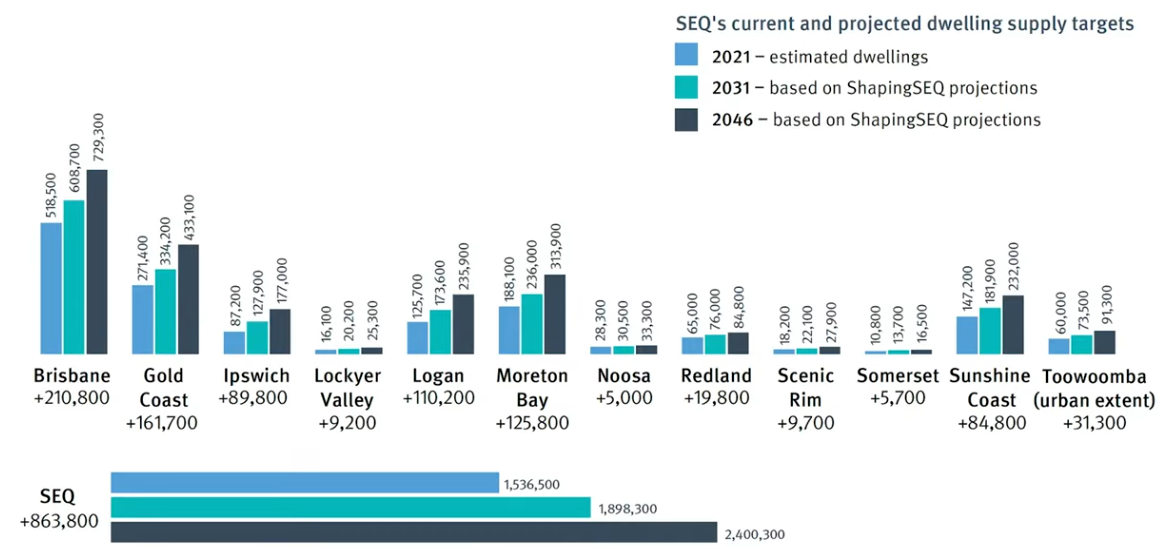
For investors, this distinction matters. A market can experience strong population growth, but the investment implications depend on whether new housing can be delivered in sufficient quantities and at prices buyers and tenants can afford.
Terry Ryder’s Hotspotting research keeps returning to the same point: supply and demand, not headlines, decide where prices go. Our own look at the Brisbane numbers is in Brisbane’s housing supply crisis.
Why New Housing Is Proving Difficult to Deliver
Construction costs and builder capacity
The supply challenge is not simply a matter of identifying available land.
Residential construction requires builders with the financial capacity, workforce and operational resources to deliver projects.
In South East Queensland, the pool of larger builders capable of undertaking multiple substantial projects has been described as relatively limited.
Even where demand exists, builders can only deliver a finite number of projects simultaneously. This creates a bottleneck between development approvals and completed housing.
Construction costs also affect the feasibility of new projects. When land, labour, materials, finance and compliance costs increase, developers must achieve higher selling prices or rental returns to justify construction.
Projects that cannot meet these feasibility requirements may be delayed, redesigned or abandoned.
The shortage of affordable apartment supply
Apartment construction illustrates this challenge particularly clearly.
New apartment developments in locations such as Brisbane’s inner city and the Gold Coast have increasingly focused on higher-value products.
Recent industry commentary has put construction and selling economics above approximately $22,000 per square metre in some higher-end apartment projects.
While these developments may be commercially feasible, they serve a narrower section of the buyer market.
The larger pool of households seeking more affordable accommodation may have fewer suitable new apartment options.
This creates a disconnect between the type of housing the market needs and the type of housing that developers can economically deliver.
Distinguish between genuine housing demand and demand for a particular product at a particular price. See our guides to apartments and townhouses in Brisbane and buying off the plan.
Land Availability and Planning Constraints
Land supply is another major consideration, particularly on the Gold Coast and Sunshine Coast.
Although new residential growth areas exist across South East Queensland, the release of additional land is influenced by planning frameworks, infrastructure requirements and government decisions.
Industry commentary has highlighted the importance of the South East Queensland Regional Plan (ShapingSEQ) and the potential for future changes to the urban footprint.
However, expanding the urban footprint is not an immediate solution. Land must still be appropriately zoned, serviced, approved and developed before it becomes available for residential construction.
This means that even where future housing capacity is identified, there can be a considerable delay before new dwellings reach the market.
Investors should therefore distinguish between:
- Land that is already approved and development-ready.
- Land identified for future urban expansion.
- Proposed infrastructure and planning changes.
- Projects that have secured the necessary approvals and funding.
These categories carry very different levels of certainty. Our Queensland locations to watch in 2026 applies this test to specific growth corridors.
Will South East Queensland Continue to Experience Capital Growth?
The exceptional growth recorded over the preceding five-year period should not automatically be extrapolated into the future.
Some industry commentary suggests further substantial growth is possible, with a 35–40% increase over the next five years discussed as one scenario.
That figure should be treated as an individual market outlook, not a guaranteed forecast or a current independently verified projection.
The broader investment case rests on several factors:
Population growth
Continued demand for housing can support both rental markets and established property values.
Limited supply
Constraints on land, construction capacity and development feasibility may restrict the rate at which new housing becomes available.
Infrastructure and employment
Transport, health, education and employment investment can influence the attractiveness of individual locations, including the lead-up to the 2032 Games.
Affordability
As prices rise, the number of buyers able to enter the market becomes increasingly constrained.
These factors will not affect every suburb or property equally.
A well-located property with sustainable rental demand and limited competing supply may perform differently from an investment bought on the hope of rapid market-wide growth.
Affordability Is Becoming an Increasingly Important Consideration
One of the significant risks identified in recent industry commentary is affordability.
South East Queensland has become substantially more expensive than it was during the earlier stages of its growth cycle. The price gap between Brisbane and Melbourne has narrowed, while Sydney remains a more expensive market overall.
As property prices rise, borrowing capacity becomes a more important constraint, all the more so after the Reserve Bank lifted the cash rate to 4.60% in September 2026.
Higher purchase prices can also affect rental yields, particularly where rents do not increase at the same pace as property values.
For investors, this creates a need to assess both the purchase price and the property’s underlying income characteristics.
A location may have attractive long-term growth fundamentals, but an investment can still be poorly structured if the acquisition price, rental return, holding costs or finance requirements are unsuitable. Our Queensland locations matrix shows current new-stock prices, rents and yields by council.
07 · Due diligence
What Should Property Investors Look For?
The South East Queensland market shows why investment decisions should begin with research rather than a property listing. Examine these before committing capital.
Population and household growth
Is the area attracting new residents, and is that growth translating into genuine demand for housing?
Employment diversity
Does the local economy offer a range of employment opportunities, or is it heavily dependent on a narrow group of industries?
Rental demand
Are there established tenant markets, and does the property offer accommodation that meets the needs of those tenants?
Competing housing supply
How much new housing is approved, under construction or proposed nearby? A growing area can still face rental competition if a lot of new supply lands at once.
Infrastructure delivery
Are transport and employment projects funded and under construction, or simply proposals? Avoid paying a premium for benefits that may be delayed or never delivered.
Price and fundamentals
Is there a reasonable relationship between acquisition cost, rental income, ongoing expenses and your long-term objectives?
These considerations are particularly important in markets where previous capital growth has created strong buyer expectations.
The Opportunity Is in Understanding the Market, Not Chasing It
South East Queensland continues to present a compelling housing market to investigate because of its population appeal and the difficulties associated with delivering additional housing.
However, strong market fundamentals do not eliminate investment risk.
The next phase of the market may be more selective than the extraordinary growth period experienced previously. Affordability, rental yields, supply pipelines and property quality are likely to become increasingly important in distinguishing between investment opportunities.
For investors, the objective should not be to purchase simply because a region has performed well.
It should be to identify investment-grade property in locations where population, employment, infrastructure, rental demand and supply conditions align with a clearly defined investment strategy.
At properT network, our approach is straightforward:
The right investment begins with understanding what the investor needs to achieve, then identifying the locations and property types that may support those objectives. More on that in Strategy Before Property.
South East Queensland deserves attention, but every acquisition still needs to stand on its own investment merits.
Read the investor summary of this article on properT network.
Keep researching
Related Reading
Brisbane housing supply crisis
Why Brisbane is short of homes and what it means for owners and renters.
Read the articleSources: ShapingSEQ 2023 Update, Queensland Government; Hotspotting: Supply and demand 101; CommBank on the RBA September 2026 decision. Growth scenarios quoted are individual market outlooks, not forecasts.
Strategy Before Property
Is South East Queensland Right for Your Strategy?
Share your budget, whether you want cash flow or growth, and your time frame, and Stephen Lazar will build a shortlist of SEQ locations and projects that fit.
One Network. Nationwide Reach.
Part Of The properT network Family
Investment Property Queensland is one specialist site within the properT network group — the same independent advisory approach, applied across states and property types.

