Brisbane · Housing Supply · September 2026
Brisbane Property Market Outlook 2026: Supply, Demand & Investment
Brisbane needs about 105,000 more homes by 2046 while approvals lag. What the supply shortfall means for rents, prices and investors in 2026.
Brisbane Needs More Than 105,000 New Homes: What It Means for Property Investors
Brisbane has become one of Australia’s most closely watched property markets and for all the right reasons.
But for property investors, the real story is about far more than simply looking at how much property prices have increased.
The more important question is what is happening beneath the surface.
Brisbane is experiencing significant population growth, employment expansion and infrastructure investment. At the same time, the supply of new housing is desperately struggling to keep pace with the growing number of people who need somewhere to live.
A recent Brisbane market outlook prepared by Urbis highlights what could become one of the most important long-term challenges for South East Queensland:
Can enough new homes actually be delivered to meet growing demand?
For investors considering an Investment Property in Queensland, understanding the relationship between population growth, employment, housing supply and rental demand is critical.
The broader investment fundamentals supporting Brisbane have also been explored in our Brisbane Property Market Outlook 2026. This article takes a deeper look at one of the most significant issues facing the market: whether Brisbane can deliver enough housing to accommodate its future population growth.
Brisbane Is the Economic Engine Room of Queensland
Brisbane continues to play an increasingly important role in the Queensland and Australian economies.
According to the Urbis market outlook, Brisbane contributed approximately $201 billion to the Australian economy in 2024 and is forecast to grow to around $275 billion by 2041.
Importantly, Brisbane’s economy is also becoming increasingly diverse.
While traditional industries remain important, the city has strong employment sectors in areas including:
- Health care and social assistance
- Professional, scientific and technical services
- Education and training
- Retail
- Accommodation and food services
This is important for property investors.
Strong property markets are generally supported by more than population growth alone. People need reasons to live in an area, and employment opportunities are a major part of that equation.
A growing and increasingly diverse economy can create demand for housing from workers, families, students and professionals across a broad range of industries.
Brisbane’s employment base has also expanded significantly. The report indicates that employment increased by approximately 274,000 over the past five years, with jobs projected to increase by around 32% between 2024 and 2046.
This growing employment base will inevitably create additional demand for housing.
Brisbane’s Population Growth Continues with Strength
Population growth is one of the most important factors influencing long-term housing demand.
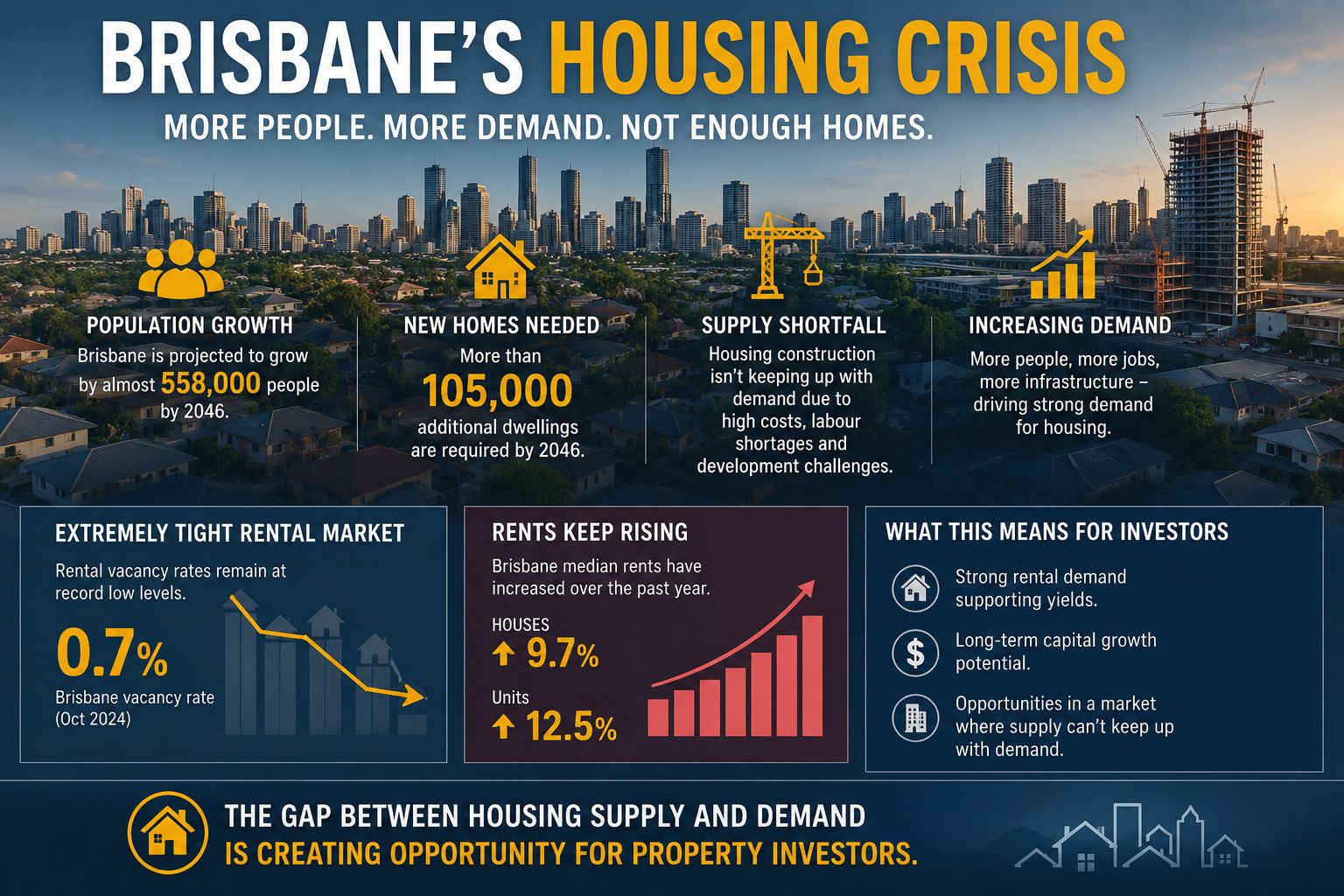
Greater Brisbane is projected to grow by almost 558,000 people over the 20 years to 2046, taking the population to approximately 3.429 million people.
That represents a substantial number of additional people requiring somewhere to live.
Queensland continues to attract people from both overseas and interstate. Investors wanting to follow broader population trends can refer to the Australian Bureau of Statistics population data.
The Urbis report identifies both overseas migration and increasing interstate migration as important contributors to Queensland’s population growth.
Interstate migration has averaged around 7,700 arrivals per quarter over the past five years, compared with approximately 5,400 per quarter during the preceding five years.
The important point for property investors is not simply that Brisbane’s population is growing.
It is the impact that population growth has on the existing housing market.
More people ultimately means more demand for:
- Houses
- Townhouses
- Apartments
- Co-Living
- Dual Keys
- Rental accommodation
- Housing close to employment centres
- Housing close to transport and lifestyle amenities
Brisbane does not exist in isolation. The broader South East Queensland region is also experiencing significant population and economic growth, creating both opportunities and challenges across multiple markets.
For a broader perspective on Queensland’s market fundamentals, you can also read our Queensland Property Update.
And this is where one of Brisbane’s biggest challenges begins to emerge.
Brisbane Needs More Than 105,000 Additional Homes
The Urbis report estimates that population growth across Brisbane will create demand for approximately:
105,570 additional dwellings by 2046
That represents an average requirement of approximately:
5,278 additional dwellings every year for the next 20 years.
This is an enormous challenge that so far is not being met meaning a compounding issue of growing demand and supply unable to meet the demand.
What does this do to the value of property and the inflationary effect it will have on Rents – your investment opportunity.
Housing demand does not wait for new homes to be built.
People continue arriving in Brisbane. They continue forming households, starting families, attending universities and moving closer to employment opportunities.
If housing supply does not keep pace with this growth, pressure can increase on the existing housing market.
This can affect:
- Property prices
- Rental demand
- Rental vacancy rates
- Rental growth
- Competition for well-located housing
The key issue for Brisbane is therefore not simply population growth.
The critical question is whether the construction industry and development sector can deliver enough homes to accommodate that growth.
The Housing Supply Challenge Is Growing
South East Queensland has ambitious housing delivery targets under the South East Queensland Regional Plan, ShapingSEQ 2023.
The South East Queensland Regional Plan identified a need for Brisbane to deliver almost 8,000 attached dwellings per annum through to 2031, followed by more than 7,100 attached dwellings per annum from 2032 through to 2046.
However, the Urbis report highlights a significant problem.
Less than 50% of this annual requirement has been delivered each year since 2019.
This represents a significant gap between the number of dwellings required and the number actually being delivered.
There are several reasons why increasing housing supply is not as simple as approving more developments.
The report identifies challenges including:
- Rising construction costs
- Labour shortages
- Limited availability of large development sites in desirable locations
- Difficulties around development feasibility
This creates an important distinction that property investors need to understand.
Planning Approval Does Not Automatically Mean New Housing
Investors often hear that thousands of apartments or houses are “in the pipeline”.
But a development application or planning approval does not automatically mean that those homes will be completed.
Before a project becomes actual housing supply, it generally needs to:
- Be financially viable
- Obtain funding
- Secure construction financing
- Manage construction costs
- Obtain sufficient labour and materials
- Be built
- Be completed
A project can be approved but never proceed to construction.
This is particularly important when analysing future supply in a property market.
The number of approved developments is not necessarily the same as the number of properties that will actually become available for buyers and tenants.
The Urbis report specifically notes that rising construction costs and labour shortages may mean only a proportion of approved developments proceed through to construction and completion.
Apartment Supply Is Well Below Previous Levels
The report highlights the challenges facing the Inner Brisbane apartment market.
Apartment settlements reached approximately 7,000 per year during the peak years of 2016 and 2017.
However, although there was an improvement in new apartment settlements during 2025, approximately 3,000 new apartments were completed.
That is significantly below the previous peak levels.
The report suggests that this level of supply will not be sufficient to meet either current and forecast population growth or the housing delivery targets identified for the region.
At the end of March 2026, there were approximately 1,100 surveyed new apartments remaining for sale across Inner Brisbane.
Again, this highlights an important issue.
Brisbane is expected to experience substantial population growth, yet the ability to deliver new apartments is being constrained by:
- Construction costs
- Labour shortages
- Development feasibility
- Limited suitable development sites
The gap between housing demand and new supply therefore has the potential to remain an important issue for the Brisbane property market.
Brisbane’s Rental Market Remains Extremely Tight
For property investors, one of the most significant indicators in the report is the rental market.
Residential vacancy rates across Brisbane were reported as ranging between approximately:
0.7% and 1.0%
These levels represent an extremely tight rental market.
Low vacancy rates indicate that there are relatively few rental properties available compared with the number of people looking for accommodation.
The report also highlights declining numbers of rental bonds across several unit categories over the previous five years.
Two-bedroom units experienced the largest decline, with the number of rental bonds falling by approximately 8.3%.
This creates further pressure on the rental market.
The relationship is relatively straightforward.
When:
Population growth increases
while:
Housing supply remains constrained
and:
Rental vacancy rates remain low
there can be significant competition for available rental accommodation.
For investors, this reinforces the importance of considering rental demand when selecting an investment property.
Buying an investment property should not simply be about predicting future capital growth.
Investors should also consider:
- Who will rent the property?
- Why will tenants want to live in that location?
- What employment opportunities are nearby?
- What infrastructure supports the area?
- How much competing rental supply exists?
- Is the property type suited to local demand?
Brisbane’s Growing Employment Base Creates Housing Demand
Another important factor supporting Brisbane’s residential property market is employment.
The city’s largest employment sector is Health Care and Social Assistance, accounting for approximately 16.4% of employment within the Brisbane LGA.
Professional, Scientific and Technical Services is the second-largest sector at approximately 12%.
Education and Training accounts for approximately 10.2%.
These industries create demand for a broad range of housing.
Brisbane attracts:
- Medical professionals
- Health care workers
- Professionals and technical specialists
- University students
- Academic staff
- International students
- Young professionals
- Families
The report notes that Brisbane’s increasingly diverse employment base is creating broad and stable residential demand.
This is particularly important for investors.
A property market supported by a range of employment sectors can potentially have a more diverse tenant base than a location heavily dependent upon one major industry.
Follow the Jobs, But Also Follow the Infrastructure
Brisbane is currently undergoing significant infrastructure development.
The Urbis report refers to a $116.8 billion Queensland infrastructure pipeline, with major investment supporting population growth and development associated with the 2032 Brisbane Olympic and Paralympic Games.
However, property investors should remember that infrastructure announcements alone do not automatically make every nearby property a good investment.
The important consideration is how infrastructure may improve:
- Accessibility
- Employment opportunities
- Liveability
- Transport connections
- Tenant demand
- Long-term desirability
One of Brisbane’s most significant infrastructure projects is Cross River Rail.
According to the Urbis report, the project involves a 10.2-kilometre rail line, four new underground stations and 5.9 kilometres of twin tunnels beneath the Brisbane River and CBD, with the report indicating an opening in 2029.
The report also highlights several other major projects and developments across Brisbane, including:
- Brisbane Airport upgrades
- Eagle Street Pier redevelopment
- The Griffith University CBD campus
- South Bank planning
- Olympic-related infrastructure
Together, these projects demonstrate the broader transformation occurring across Brisbane.
For more on the broader reasons investors continue to focus on Brisbane and South East Queensland, read our Brisbane Property Market Outlook 2026.
Infrastructure Alone Does Not Make Every Property a Good Investment
This is an important distinction. Historically new infrastructure that is significant to the location has tended to increase property values in and around this new infrastructure.
An investor should not simply invest in a property because:
- A railway is being built nearby
- The Olympics are coming
- A new hospital is planned
- A university is expanding
The property itself still needs to meet appropriate investment criteria. Meaning the property needs to meet Investment Grade criteria first and foremost.
Investors should consider:
- Location
- Land component
- Supply and demand
- Property type, age and floor plan
- Tenant demand
- Price
- Rental yield
- Future competing supply
- Infrastructure
- Employment
- Their individual investment objectives
- Exit strategy
- Cash flow required to hold and fund the investment
The best investment decision is not necessarily about buying in the suburb with the biggest announcement.
It is about identifying a property that matches a carefully considered investment strategy to ensure it is worthy of your Investment Dollars.
What About the Brisbane 2032 Olympic Games?
The Brisbane 2032 Olympic and Paralympic Games are undoubtedly an important part of the city’s future development.
However, investors should look beyond the Games themselves. Will the Games add to the ongoing viability of those locations?
The Olympics will only last for a relatively short period.
The more important question is:
What infrastructure and economic activity will remain and add value after 2032?
The potential long-term benefit is not necessarily the Games themselves.
It is the infrastructure and investment that is being accelerated to support Brisbane’s continued development.
Brisbane was already experiencing:
- Population growth
- Employment growth
- Interstate migration
- Overseas migration
- Housing demand
The Olympics can therefore be viewed as an additional catalyst accelerating investment into a city that was already growing.
The Urbis report notes that infrastructure associated with the Games is intended to provide benefits well beyond 2032.
For a deeper examination of this longer-term investment theme, read our article on The Queensland Olympic Effect: A Once-in-a-Generation Property Investment Opportunity.
Why Supply and Demand Will Remain Critical
The fundamental story emerging from the Brisbane market is the relationship between:
Growing Demand
and
Constrained Supply
Demand is being influenced by:
- Population growth
- Interstate migration
- Overseas migration
- Employment growth
- Economic expansion
- Brisbane’s lifestyle and liveability
At the same time, new supply is being constrained by:
- Rising construction costs
- Labour shortages
- Limited development sites
- Development feasibility
- Insufficient housing delivery
This does not mean every property in Brisbane will automatically perform well.
Property markets are far more complicated than that.
Different suburbs can perform differently.
Different property types can perform differently.
A new apartment development with significant future competing supply may face different market conditions to a detached home in a tightly held location.
That is why investors need to look beyond broad headlines about “Brisbane property”.
The ‘Right’ Property Matters More Than Simply Investing in the Right City
Brisbane may have strong long-term fundamentals, but that does not mean investors should simply buy any property in Brisbane.
This is where a considered investment strategy becomes important.
At properT network, we believe there is an important difference between simply buying a property and investing in property.
Anyone can buy a property.
The more important question is:
“Is this the right property for your particular investment objectives?“
An Investment Property should be assessed according to factors including:
- Your available budget
- Your borrowing capacity
- Your investment timeframe
- Your income requirements
- Your appetite for growth versus yield
- Your existing portfolio
- Your tax position
- Your long-term financial objectives
- Your purpose for the investment
A high-yield investment property may suit one investor. A property selected primarily for long-term capital growth may suit another.A combination of Growth + Yield will suit another.
An established property may suit one investors investment objectives, whilst a New Build would suit other investors purpose for the investment, cash flow and investment strategy.
There is no single property that is automatically right for every investor. On the other hand, there are properties that should be avoided too.
The Brisbane Housing Supply Outlook
The latest data paints a picture of a city continuing to grow.
Brisbane has:
- A growing population
- An increasingly diverse economy
- Strong employment growth
- Significant infrastructure investment
- Extremely low rental vacancy rates
- Increasing pressure on the housing market
Perhaps the most important issue, however, is housing supply.
Greater Brisbane is expected to require more than 105,000 additional dwellings by 2046.
At the same time, housing delivery has been struggling to keep pace with the targets required to accommodate future growth.
For property investors, this is a fundamental issue worth watching closely.
Because ultimately, property markets are influenced by people needing somewhere to live.
And when population and employment continue to grow faster than the supply of suitable housing, pressure on existing housing can increase.
Final Thoughts for Property Investors
Brisbane’s property market should can not be assessed simply by looking at what property prices have done over the past few years. Queensland and Australia continues to change and evolve, past history is no indication of the future.
The more important question you want to be asking is:
“What is happening underneath the market?”
The underlying fundamentals highlighted in the latest Brisbane market outlook include:
- Strong population growth
- More than half a million additional Greater Brisbane residents projected by 2046
- More than 105,000 additional dwellings required
- Significant employment growth
- A diverse and expanding economy
- Major infrastructure investment
- Extremely low rental vacancy rates
- Housing supply struggling to keep pace with demand
These factors will continue to be important considerations for anyone looking at investment property opportunities in Queensland.
However, successful property investment is not about chasing headlines or simply buying in the latest hotspot.
It is about understanding the fundamentals and then selecting the right property for the right purpose.
Anyone can buy a property.
“The real challenge is ensuring that the property you Invest in is an investment that works hard for you and helps you move closer to your financial objectives over the life of the investment.“
Considering an Investment Property in Queensland?
If you are considering an Investment Property in Queensland, the first step should not necessarily be searching for a property.
The first step should be understanding your:
- Investment objectives and reason why you are investing
- Available budget
- Borrowing capacity
- Preferred investment strategy and outcome
- Capital growth requirements
- Rental Income requirements
- To hold and live off the yield or to sell for equity
Once those objectives are clear, the focus can shift towards identifying the type of investment property and location that best matches your strategy.
At properT network, our focus is on helping investors make informed decisions by matching the ‘right’ investment property to the right investor and their individual objectives.
The objective is not simply to buy a property. It is to invest in the ‘best fit‘ property for the right purpose.
Source and Important Information
This article draws on the Brisbane Market Outlook, prepared by Urbis in August 2026. The report was prepared for Position Property. Data, projections and forecasts should be considered in the context of the report’s stated assumptions and limitations. Past performance is not necessarily an indication of future performance.
Related Property Investment Resources
https://propertnetwork.com.au/multigenerational-smsf-planning/
Read next: Brisbane Property Market 2026: Why Investors May Be Running Out of Time.
More on Brisbane and Across the properT network
Our latest builder and developer stock lists (July–October 2026) include 59 new listings in Brisbane, from $685k to $4.35m with a median of $1.41m.
- Brisbane property investment: suburbs, new stock, prices and rents
- Brisbane property market 2026: why investors may be running out of time
- Brisbane apartments and townhouses
- Compare all Queensland councils on the LGA matrix
- Strategy before property (properT network)
- Australia’s rental crisis and housing supply (properT network)
- Queensland demand surging, supply unable to keep up (properT network)
- Caboolture & Morayfield: the northern growth corridor (Queensland)
General information only, current at the date of publication. Market conditions change; please speak with us before acting on any figures in this article.
Strategy Before Property
Is Brisbane Right for Your Strategy?
Share your budget, whether you want cash flow or growth, and your time frame, and Stephen Lazar will build a shortlist of locations and projects that fit.
One Network. Nationwide Reach.
Part Of The properT network Family
Investment Property Queensland is one specialist site within the properT network group — the same independent advisory approach, applied across states and property types.